A Step-by-Step Guide Through Global Tragedy (1914–1918)
World War I wasn’t just a clash of armies—it was a rupture in history. It shattered empires, redrew maps, and left lasting scars across the globe. Between 1914 and 1918, the world witnessed the birth of modern warfare—with trenches, chemical weapons, air battles, and the deaths of millions. But how did this nightmare begin? And how did it unfold, year by year?
Below is a detailed timeline of the major events of World War I, organized by year and month—like reading the dark chapters of a very real, very brutal history.
1914 – The Year Everything Exploded
- June 28: Archduke Franz Ferdinand, heir to the Austro-Hungarian throne, is assassinated in Sarajevo. One bullet would ignite a global fire.
- July 28: The Austro-Hungarian Empire declares war on Serbia. Europe begins to move like a row of falling dominoes.
- August 1: Germany mobilizes its troops and declares war on Russia, Serbia’s ally.
- August 2: German troops invade Belgium, violating its neutrality and shocking the international community.
- August 3: Germany declares war on France. The Western Front opens.
- August 4: Britain declares war on Germany in response to the invasion of Belgium. World War I officially begins.
- August 6: Austria-Hungary declares war on Russia, opening the Eastern Front.
- August 15–23: German and French troops clash fiercely along their borders in the first major ground battles.
- August 20: German troops march into Brussels, the capital of Belgium.
- August 23: Japan declares war on Germany, bringing the conflict to Asia.
- September 2: German troops invade French territory, advancing dangerously close to Paris.
- November 1: The Ottoman Empire joins the war on the side of Germany and the Central Powers.
- November 5: The Allied Powers—France, the UK, and Russia—declare war on the Ottoman Empire.
1915 – New Fronts, New Allies
- February 19: The Allies launch a naval offensive against the Ottoman Empire in the Dardanelles, beginning the Gallipoli Campaign.
- May 23: Italy abandons neutrality and joins the war on the side of the Allies, declaring war on Austria-Hungary.
- June 23: The first battles between Italians and Austrians break out in the mountains of northern Italy.
- October 1: Allied troops land in Salonika, Greece, opening a new Balkan front.
- October 5: Bulgaria declares war on the Allies, joining the Central Powers.
- October 6: Austro-Hungarian and Bulgarian forces launch a joint attack on Serbia, which suffers heavy losses.
1916 – The Year of the Giant Battlefields
- February 21: Germany launches the Battle of Verdun against France—one of the bloodiest and longest battles of the war.
- March 9: Germany declares war on Portugal after colonial tensions in Africa.
- July 1: The Battle of the Somme begins. French and British troops launch a massive offensive. More than 1 million soldiers will be killed or wounded.
- August 27: Romania joins the Allies and declares war on Austria-Hungary.
- November 18: The Battle of the Somme ends with little territorial gain and horrific human cost.
- December 18: The Battle of Verdun finally ends. France holds, but at the cost of over 700,000 casualties.
1917 – Revolutions, Gas, and America Enters the War
- February 1: Germany resumes unrestricted submarine warfare, targeting all ships, including those from neutral nations.
- February 5: The United States breaks diplomatic relations with Germany.
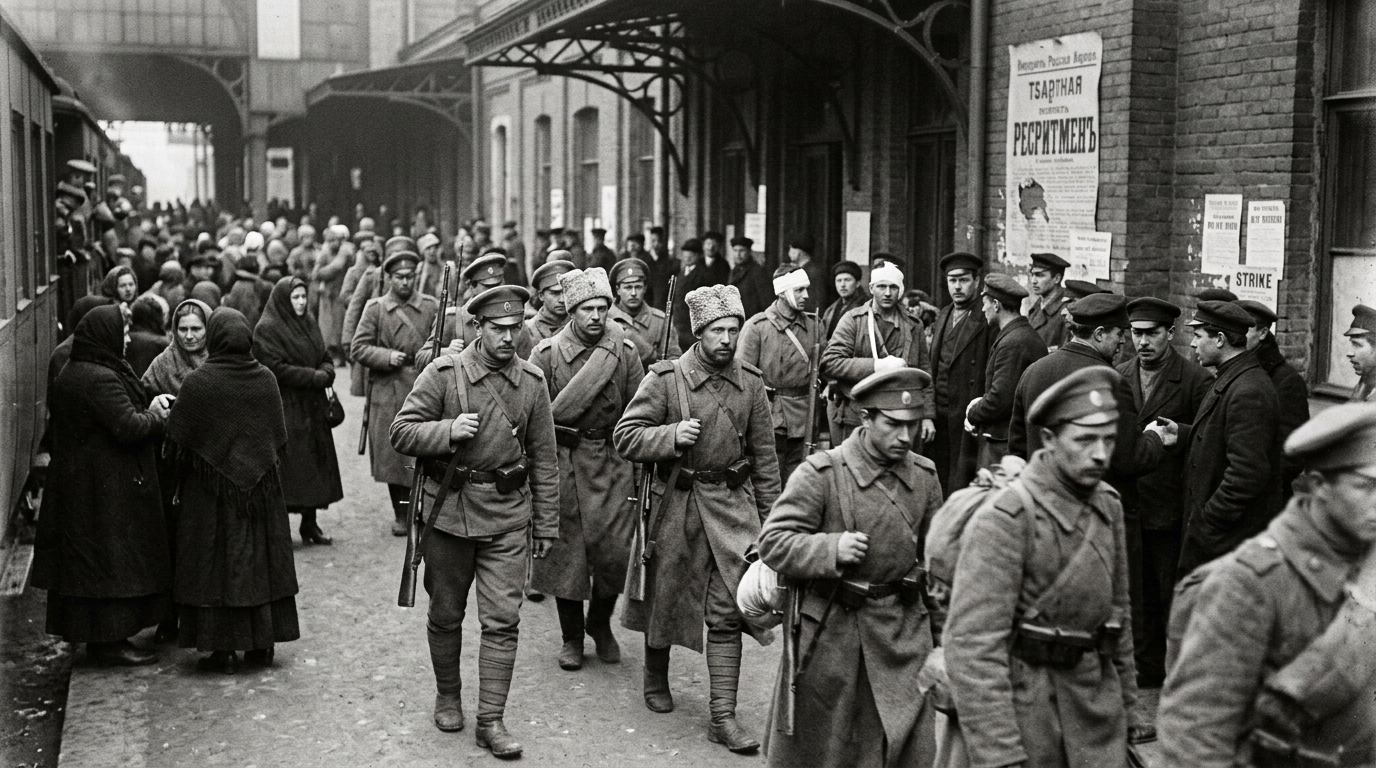
- March 8–12: The February Revolution begins in Russia. Mass protests erupt in the streets.
- March 15: Czar Nicholas II abdicates. The Russian monarchy collapses after over 300 years.
- April 6: The United States officially enters the war on the side of the Allies.
- June 28: The first American troops land in France. A turning point begins to form.
- June 29: Greece joins the war on the side of the Allies.
- July 12–13: Germany uses mustard gas for the first time—a deadly chemical weapon that burns skin and blinds soldiers.
- August 14: China declares war on Germany, further internationalizing the conflict.
- November 2: Britain issues the Balfour Declaration, supporting the creation of a Jewish state in Palestine.
- November 6: The October Revolution erupts. Lenin takes power in Russia and sets the stage for a new communist regime.
1918 – The End of the War and the Beginning of a Pandemic
- January 8:S. President Woodrow Wilson presents his “Fourteen Points,” a plan to rebuild the world and secure peace after the war.
- March 3: Russia, now under Bolshevik control, signs the Treaty of Brest-Litovsk with the Central Powers and exits the war.
- March 23: German long-range artillery begins bombing Paris, bringing terror to the French capital.
- April 9: Germany launches a new offensive in the Flanders region, hoping to win before full American deployment.
- July 18: The Allies win the Second Battle of the Marne. It marks a decisive shift toward Allied victory.
- September 26: The Allies launch the Hundred Days Offensive—successive blows that begin collapsing the German front.
- October: The Spanish Flu pandemic begins, ultimately killing over 50 million people worldwide, far more than the war itself.
- November 11: France and Germany sign the Armistice of Rethondes. At 11 a.m. on the 11th day of the 11th month, the guns fall silent. World War I is over.