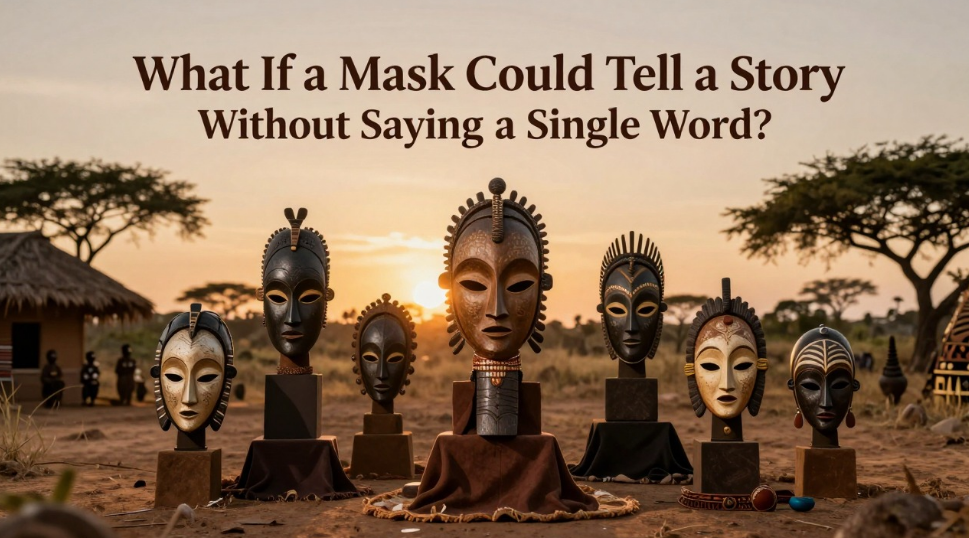
What If a Mask Could Tell a Story Without Saying a Single Word?
Across Africa, ritual masks have done exactly that for generations.
At first glance, an African mask may appear to be a beautifully carved object, an impressive work of traditional art, or an intriguing piece of cultural heritage. But behind its eyes, shapes, colors, and expressions lies something much deeper: stories about ancestors, spirituality, identity, courage, transformation, and the mysteries of life and death.
For centuries, African ritual masks have occupied an important place in ceremonies, dances, initiations, funerals, and spiritual traditions. Their meanings are not universal, however. A mask that represents one idea in one community may have a completely different significance somewhere else.
That is precisely what makes African masks so fascinating.
They are not simply objects to be admired. In their original cultural contexts, many were created to be part of an experience — surrounded by music, movement, ceremony, community, and belief.
So, what secrets do these remarkable masks hold?
More Than Art: What Do African Masks Symbolize?
One of the biggest misconceptions about African masks is that they were created primarily as decorative objects.
In many traditional contexts, the opposite is closer to the truth.
A mask could become part of a ceremony in which the wearer temporarily represented an ancestor, spirit, animal, social ideal, or other powerful symbolic presence.
The meaning depended on several factors, including:
- The community that created it
- The occasion where it was used
- The person wearing it
- The movements and dances accompanying it
- The materials and symbols incorporated into its design
- The spiritual or social beliefs connected to the ceremony
This means that simply looking at a mask in a museum cannot always reveal its complete meaning.
Imagine seeing a carved wooden face behind glass. You can appreciate its craftsmanship, but you cannot hear the drums, watch the dance, see the surrounding community, or understand the ceremony that once gave the object its full significance.
That missing context is often where the most fascinating stories begin.
Battle Masks: When Courage Became a Symbol
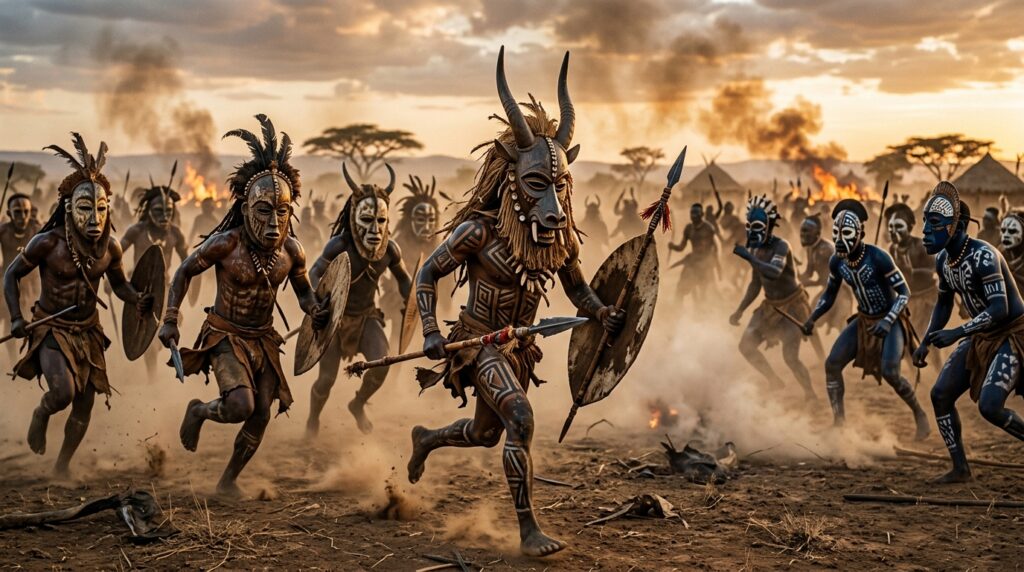
Throughout history, certain African communities incorporated masks or ceremonial headgear into traditions connected with warriors, leadership, protection, and conflict.
These objects could symbolize qualities that a warrior was expected to embody:
- Courage
- Strength
- Discipline
- Leadership
- Protection
- Fearlessness
Animal imagery was particularly powerful.
Lions, leopards, crocodiles, birds, and other animals could appear in African traditional art because they carried symbolic associations with qualities such as strength, intelligence, speed, authority, or spiritual power.
But there is an important distinction to make.
Not every African mask depicting an animal was a “battle mask,” and not every mask was intended for actual combat. In many cases, the connection was ceremonial or symbolic rather than practical.
The mask was part of a larger cultural language.
Why Animal Symbols Were So Powerful
Animals have always played important roles in human storytelling. In many African artistic traditions, they could represent qualities that humans admired, feared, or respected.
A powerful animal might symbolize:
“Become what this creature represents.”
The mask therefore became more than an object placed over the face. It could help communicate an identity, an ideal, or a relationship between the human world and the natural or spiritual world.
That transformation is one of the most intriguing aspects of traditional African masks.
Funerary Masks: Remembering Those Who Came Before
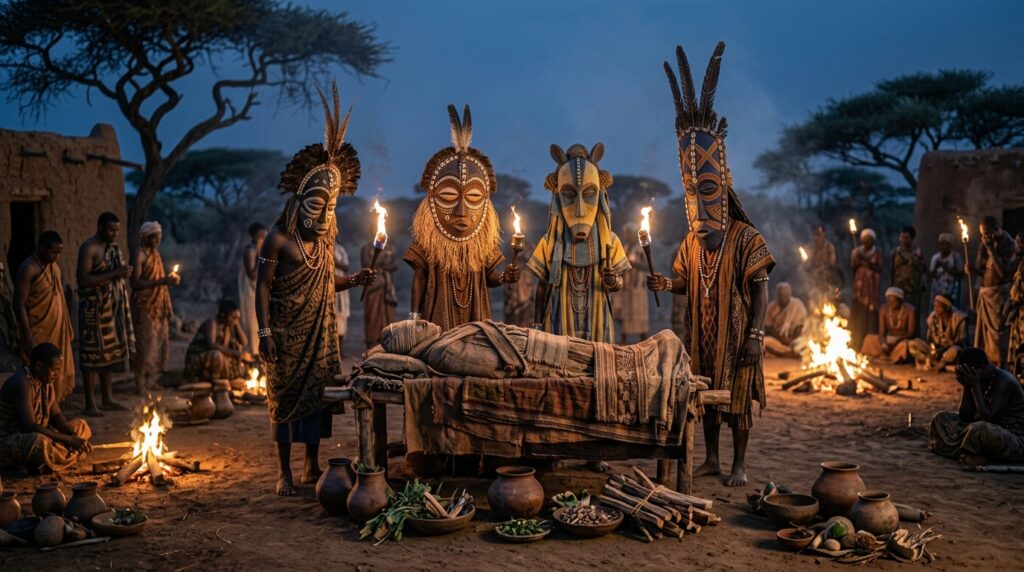
Few subjects are as universal as death.
Every society develops its own ways of remembering the people who came before. In several African cultures, masks have played roles in funerary traditions, commemorations, and ceremonies connected with ancestors.
These traditions vary enormously from one community to another, so there is no single “African funerary mask tradition.”
Instead, there are many different approaches to honoring the dead.
In some contexts, masks could help express ideas about:
- Ancestral presence
- Continuity between generations
- Memory
- Social status
- Spiritual transition
- Respect for the deceased
The mask could become a visual reminder that death did not necessarily mean the complete disappearance of a person from the community’s spiritual or cultural world.
The Ancestor and the Living
The relationship between the living and ancestors is an important theme in numerous African religious and cultural traditions.
A funerary ceremony might therefore be about much more than saying goodbye.
It could also be about remembering.
A mask might embody the qualities associated with a respected person or represent a broader ancestral presence. Through music, dance, storytelling, and ceremony, the community could reaffirm its connection with previous generations.
This makes African funerary masks particularly powerful examples of how art can become intertwined with memory.
Religious Masks: When the Face Becomes a Symbol
Perhaps the most mysterious African masks are those associated with spiritual and religious ceremonies.
In certain traditions, masks have been used in dances and rituals connected with spirits, ancestors, deities, or supernatural forces.
But again, the details differ greatly between cultures.
The person wearing a ritual mask may not simply be “pretending to be” a spirit. The ceremony can involve a much more complex idea of representation, transformation, identity, and spiritual presence.
The mask changes the way the wearer is perceived.
The individual disappears behind the symbolic identity.
And suddenly, the ceremony is no longer simply about a person.
It becomes about what the mask represents.
The Power of Ritual Dance
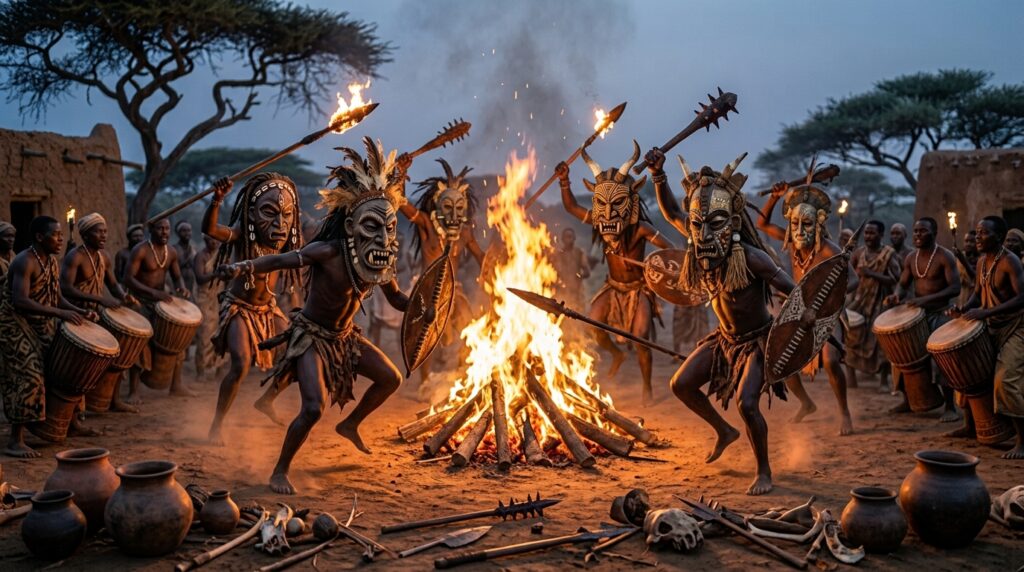
A mask often makes the most sense when considered together with movement.
Imagine:
- Drums filling the air
- A dancer moving in a carefully established pattern
- A crowd gathered around the performance
- Traditional songs accompanying the ceremony
- A carved mask appearing almost alive through movement
The mask is no longer a static sculpture.
It becomes part of a living performance.
This is why describing African masks only as “wooden sculptures” can miss an essential part of their cultural meaning.
Their original power often emerged through performance, ceremony, music, movement, and community participation.
Initiation Masks: Symbols of Transformation
Life is filled with transitions.
Childhood becomes adulthood. A student becomes a member of a profession. A person leaves one stage of life and enters another.
Many cultures have ceremonies to mark these moments, and some African societies have incorporated masks into initiation traditions.
In these contexts, masks may symbolize transformation.
The person entering a new stage of life is no longer exactly who they were before.
The mask can visually represent that change.
The Mystery Behind the Mask
There is something psychologically powerful about covering the human face.
The face is one of the strongest symbols of personal identity. When it disappears, the viewer’s attention shifts toward the character, spirit, ancestor, animal, or social role represented by the mask.
This creates a sense of mystery.
It can also teach an important cultural lesson: identity is not only about the individual. It can also be connected to family, community, ancestry, responsibility, and tradition.
That is one reason masks have appeared in initiation ceremonies across different societies.
African Masks and Cultural Identity
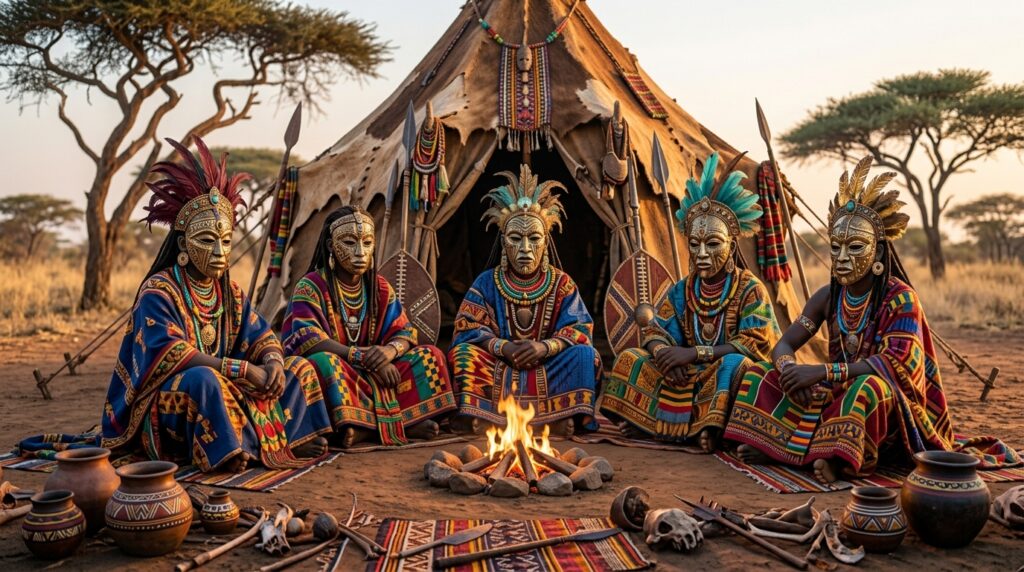
Africa is not a single culture.
It is a continent of extraordinary cultural, linguistic, religious, and artistic diversity.
That is why the expression “African mask” can sometimes be misleading.
A mask from one cultural tradition may have little in common with a mask from another beyond the fact that both were created on the African continent.
Among the traditions frequently discussed in the history of African art are those associated with communities such as the Yoruba, Dogon, Fang, Chokwe, Dan, Baule, Senufo, and many others.
Each has its own history, artistic vocabulary, ceremonies, and symbolism.
What Makes Each Tradition Different?
Differences can appear in:
- Facial proportions
- Geometric patterns
- Hairstyles
- Animal imagery
- Materials
- Colors
- Carving techniques
- Performance styles
- Religious associations
- Social functions
For this reason, one of the best ways to appreciate African masks is to ask:
Who created this mask, and why?
That question is much more revealing than simply asking what the mask “looks like.”
Famous African Masks and the Fascination of Collectors
African masks have fascinated artists, historians, collectors, museums, and travelers for generations.
Their visual impact has also influenced modern art, particularly during the 20th century. European artists encountered African artworks through exhibitions, collections, and other channels, and some incorporated aspects of African visual traditions into their own work.
However, this history is complicated.
Many African cultural objects entered international collections under circumstances that today raise important questions about colonialism, ownership, cultural heritage, and repatriation.
This is why African masks should not be viewed only as beautiful collectibles.
They can also open a much larger conversation about:
- Cultural heritage
- Colonial history
- Museum collections
- Ownership
- Repatriation
- Respect for sacred objects
- The responsibilities of collectors
The story of a mask does not necessarily end when it leaves the community where it was created.
Sometimes, that is when another chapter begins.
Materials Tell Their Own Story
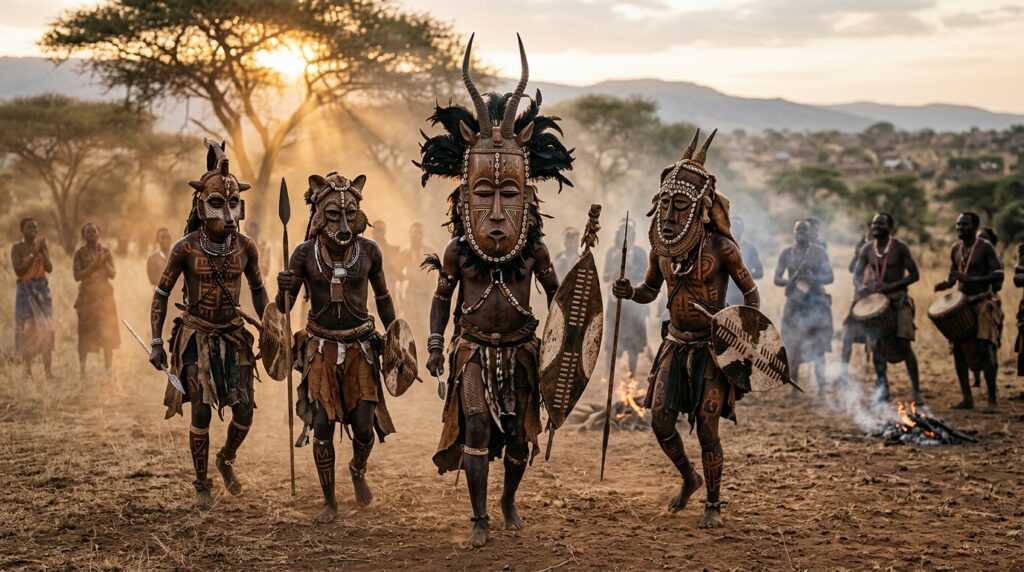
Traditional African masks were made from a wide variety of materials depending on the region, available resources, and cultural purpose.
Common materials can include:
- Wood
- Plant fibers
- Leather
- Metal
- Beads
- Pigments
- Cloth
- Animal materials
Wood became particularly important in many mask-making traditions because it could be carved into highly expressive forms.
But the material itself was only one part of the process.
The choice of shape, surface treatment, color, attachments, and decorations could all contribute to the final symbolic language.
A simple-looking mask might therefore contain layers of meaning that are invisible to someone unfamiliar with the tradition.
Why African Masks Often Look So Mysterious
Have you ever noticed how many traditional masks appear to have exaggerated eyes, elongated faces, unusual proportions, or expressions that do not resemble ordinary human portraits?
This is not necessarily an attempt to create a realistic human face.
Traditional masks often operate according to a different visual logic.
The goal may be to communicate an idea rather than reproduce someone’s exact appearance.
An oversized forehead might suggest intelligence or spiritual importance. A particular animal feature might represent a quality associated with that animal. Geometric patterns might carry cultural associations that are not immediately obvious to an outsider.
In other words, African mask symbolism is often less about realism and more about meaning.
The Mask Is Only One Part of the Story
One of the most important things to understand about African ritual masks is that the object itself may represent only one part of a much larger tradition.
A complete ritual experience could involve:
- Music
- Dance
- Costumes
- Oral traditions
- Community participation
- Sacred spaces
- Storytelling
- Ceremonial objects
Remove the mask from that environment, and its meaning can change dramatically.
This is why museums often provide extensive information about the origin and context of African masks.
A mask behind glass may look silent.
In its original setting, it may have been anything but silent.
African Masks in Museums Today
Today, African masks can be found in museums and collections around the world.
They attract visitors because of their beauty, mystery, craftsmanship, and historical importance.
But modern museums increasingly face an important question:
How should cultural objects be displayed and interpreted?
Displaying a mask without explaining its cultural background can turn a meaningful ritual object into nothing more than decoration.
Good interpretation can help visitors understand:
- Where the object came from
- Which community created it
- How it was traditionally used
- Whether it was sacred or ceremonial
- How it entered the collection
- What its cultural significance may be
The result is a more respectful and meaningful way to experience African art.
What African Masks Can Teach Us Today
Perhaps the greatest lesson of African ritual masks is that art does not always exist simply to be looked at.
Art can be used to remember.
It can be used to celebrate.
It can mark a transformation.
It can express beliefs that are difficult to put into words.
And it can connect generations.
African masks demonstrate how an object can exist at the intersection of art, spirituality, history, identity, and community.
That is what makes them so compelling even to people who have never participated in the traditions where these masks were originally used.
Final Thoughts: The Story Behind the Face
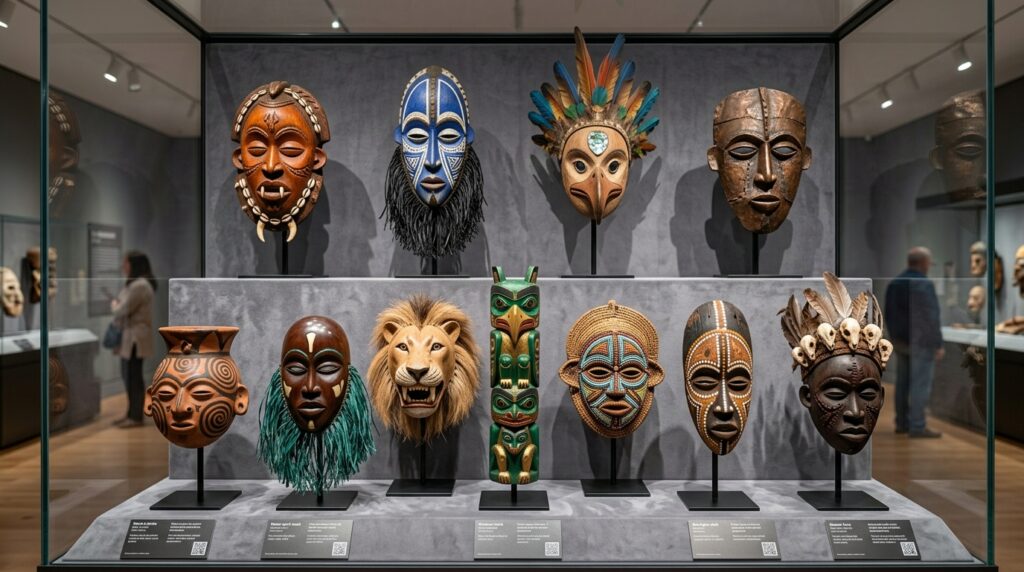
An African mask may seem mysterious because we cannot immediately understand what it represents.
But perhaps that mystery is part of its appeal.
Behind every shape and symbol may be a story about a community’s understanding of life, nature, ancestors, spirituality, courage, or transformation.
And there is an important lesson here: not every mask has the same meaning, and no single explanation can represent the enormous diversity of African cultures.
The next time you see an African mask in a museum, gallery, book, or photograph, don’t just ask:
“What does this mask look like?”
Ask instead:
“Who made it? Why was it created? Who wore it? What happened when the mask appeared?”
Those questions can transform a beautiful object into something much more fascinating — a doorway into history, culture, and human imagination.