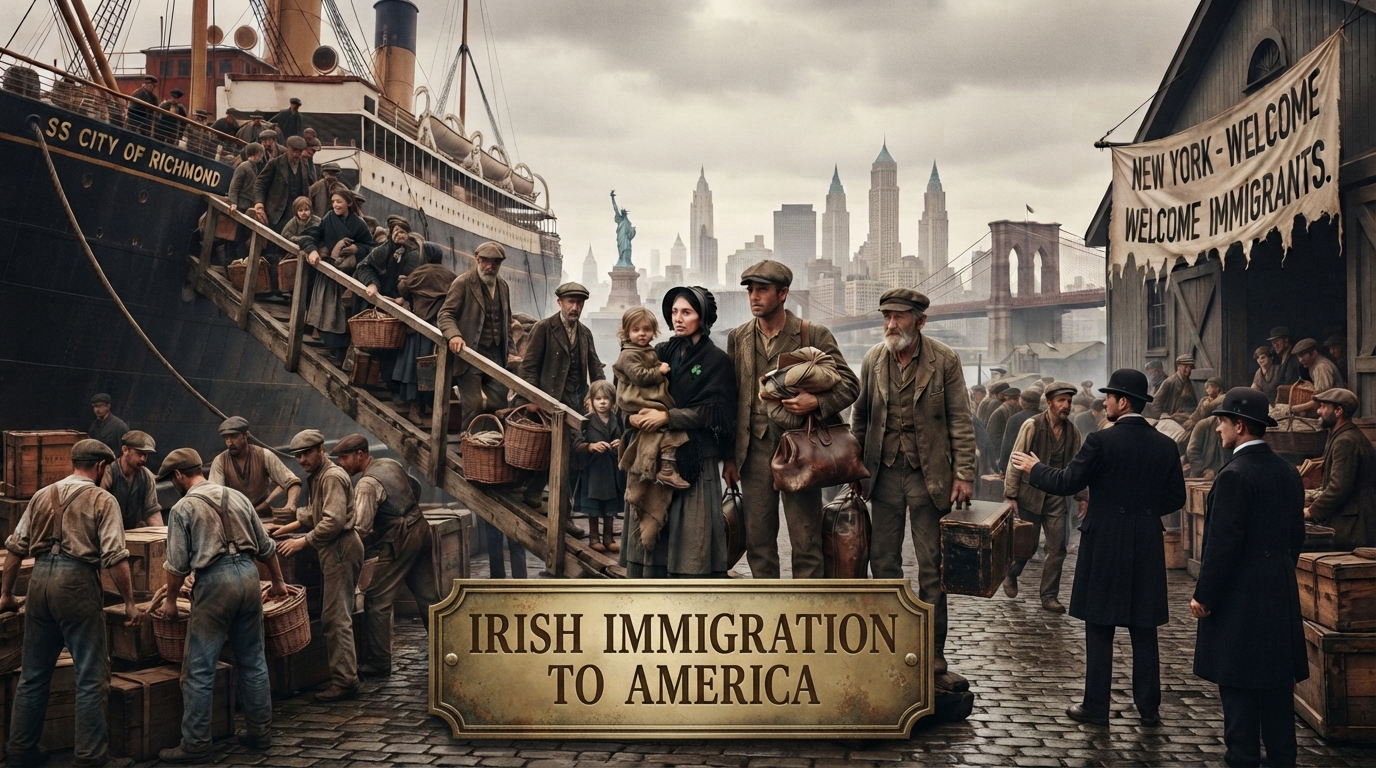
Irish Immigration to America: The Great Famine, New York, and the Making of Irish-American History
Irish immigration to America changed the history of both Ireland and the United States. During the 19th century, hundreds of thousands of Irish men, women, and children crossed the Atlantic, many arriving with limited financial resources and facing an uncertain future. Some were escaping famine and poverty, while others were responding to limited economic opportunities and hoping to build a more secure life for their families.
The story of Irish immigrants in America, however, cannot be reduced to a simple journey from poverty to prosperity. Their experience included dangerous ocean crossings, difficult working conditions, overcrowded housing, religious prejudice, political conflict, and struggles over identity and belonging. At the same time, Irish immigrants created churches, neighborhoods, businesses, political organizations, newspapers, schools, and family networks that became important parts of American society.
New York City became one of the most visible centers of Irish immigration, but the Irish-American experience extended far beyond Manhattan. Boston, Philadelphia, Chicago, San Francisco, and many smaller communities also became home to Irish immigrants and their descendants.
Understanding this history provides a broader perspective on immigration in the United States. It reveals how economic crises can drive migration, how immigrant communities establish institutions, and how identities evolve across generations.
Ireland Before Mass Immigration to America
To understand why so many people left Ireland, it is necessary to look at conditions in Ireland before the Great Famine.
During the first half of the 19th century, a large part of Ireland’s population lived in rural areas and depended heavily on agriculture. Access to land was an important issue, particularly for poor tenant farmers and rural laborers.
Many families survived on very small plots of land. The potato became especially important because it could produce a large amount of food on relatively limited acreage. For families with little access to other resources, dependence on the potato created enormous vulnerability.
Economic inequality also affected rural communities. Land ownership patterns, rents, population growth, and limited employment opportunities contributed to widespread poverty.
Ireland was also politically connected to Britain, and debates over land, political rights, religion, and national identity influenced Irish society throughout the 19th century.
These conditions did not automatically cause mass emigration, but they created an environment in which an agricultural catastrophe could have devastating consequences.
The Great Famine and Irish Emigration
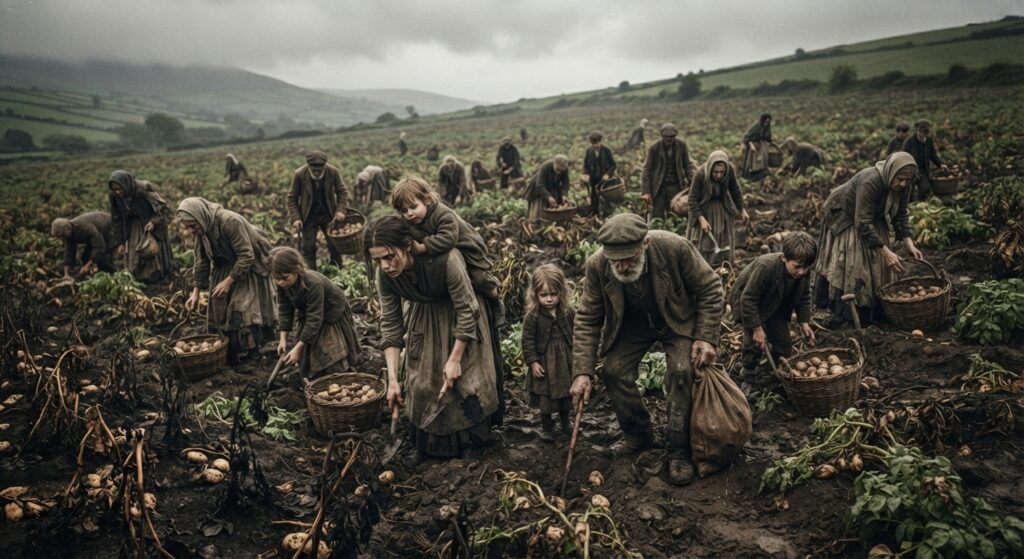
The Great Famine, often called the Irish Potato Famine, began in 1845 after a disease severely damaged potato crops.
Because so many poor families depended on potatoes as a staple food, repeated crop failures created an enormous humanitarian crisis.
Between 1845 and 1852, more than one million people died in Ireland from starvation and disease, while a much larger number left the country.
The famine transformed Irish migration.
People who might previously have considered emigration an unlikely or temporary option increasingly saw leaving Ireland as a means of survival. Families sold possessions, borrowed money, relied on relatives abroad, or pooled resources to finance journeys across the Atlantic.
The United States became one of the principal destinations.
For this reason, the history of Irish immigration to America cannot be separated from the Great Famine. Although Irish migration had existed before 1845, the famine dramatically increased the scale and urgency of emigration.
Why Did Irish Immigrants Choose America?
America offered something that was difficult to find in famine-stricken Ireland: the possibility of employment and access to a growing economy.
The United States was experiencing rapid urbanization and economic development during the 19th century. Cities needed workers for construction, transportation, factories, docks, domestic service, and other industries.
Information also traveled through immigrant networks.
An Irish person who had already settled in America could send letters or money to relatives in Ireland. These connections helped subsequent migrants understand where to go, how to find work, and whom they could contact after arriving.
This process is sometimes described as chain migration. One family member’s migration could make it easier for brothers, sisters, parents, cousins, or neighbors to follow.
As these networks expanded, Irish-American communities became increasingly established.
The Journey Across the Atlantic
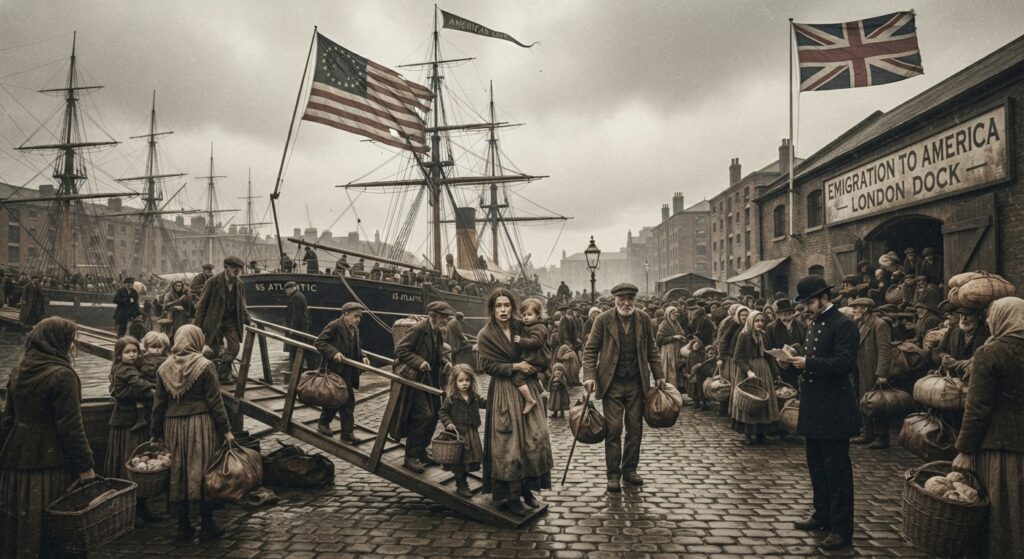
For many Irish immigrants, the journey to America was itself a major challenge.
Not every passenger traveled under the same conditions. Wealthier travelers could afford better accommodations, while poor emigrants often traveled in much more crowded conditions.
The trip could last for weeks, depending on the vessel and weather. Food, sanitation, illness, and overcrowding were serious concerns on many immigrant ships.
The experience was particularly difficult for families traveling with children.
By the time immigrants reached an American port, many had already experienced a physically and emotionally exhausting journey.
Arrival did not necessarily mean immediate security. Newly arrived immigrants still had to find housing, employment, food, and a way to navigate an unfamiliar society.
Irish Immigration to New York
New York became one of the most important destinations for Irish immigrants.
The city’s port connected the United States to Europe, while its rapidly growing economy created demand for workers.
For immigrants arriving with little money, the availability of low-skilled employment was particularly important.
Irish men often found work in construction, transportation, docks, factories, and other forms of manual labor. Irish women frequently worked in domestic service.
New York therefore offered opportunities, but those opportunities often came with difficult working and living conditions.
The Irish presence became especially visible in parts of Manhattan, where immigrant communities developed around employment opportunities and affordable housing.
Life in Irish-American Neighborhoods
The immigrant experience in New York was shaped by neighborhood life.
Poor families often lived in rented rooms or apartments in densely populated buildings. Tenement housing could be overcrowded, and sanitation problems were common in many parts of the city.
For a newly arrived family, however, living near other Irish immigrants could provide important advantages.
Neighbors might share information about jobs. Relatives could help newcomers find accommodation. Churches and charitable organizations could provide assistance. Local businesses could serve as gathering places for members of the community.
This created a paradox.
The same neighborhoods that reflected poverty and overcrowding could also become centers of community formation.
Irish immigrants were not simply isolated individuals trying to survive. They were building social networks that would help future generations become more established.
Work and Economic Mobility
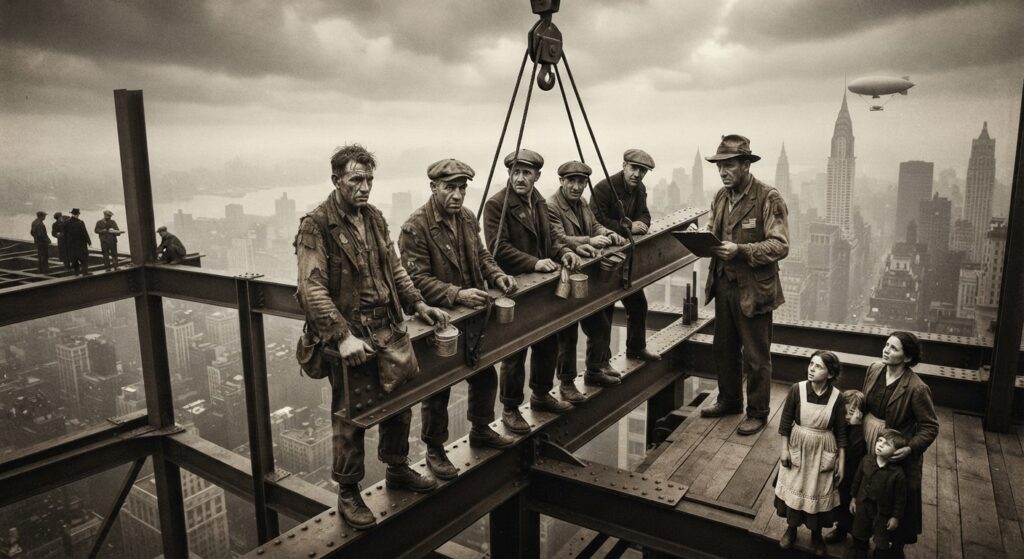
Employment was central to the Irish-American experience.
Many immigrants initially entered occupations that required physical labor and offered limited wages. Construction and domestic service were particularly important areas of employment.
Irish women played a significant economic role. Domestic service provided employment for many immigrant women and gave some the opportunity to earn wages outside the family household.
Over time, economic circumstances changed.
Some immigrants remained in low-wage occupations, while others opened businesses, acquired property, entered skilled professions, or moved to different neighborhoods.
Their children often had access to educational and occupational opportunities that had been unavailable to their parents.
This process of gradual economic mobility is an important part of Irish-American history. It demonstrates that immigrant integration was not a single event but a process that could take several generations.
Anti-Irish Prejudice and Religious Discrimination
Irish immigrants faced prejudice in many parts of American society.
Religion was one important factor. Most Irish immigrants were Catholic, while the United States had a large Protestant population. Religious differences sometimes contributed to hostility toward Irish newcomers.
Irish immigrants were also frequently associated with poverty and low-wage labor.
Political and cultural stereotypes portrayed the Irish in negative ways. Newspapers, cartoons, and popular culture sometimes depicted Irish people as uneducated, violent, or incapable of becoming part of American society.
These stereotypes affected employment and social relationships.
Yet the experience varied depending on location, occupation, wealth, generation, and individual circumstances. There was no single Irish-American experience.
As Irish communities became more established, some forms of discrimination declined, although anti-Catholic and anti-Irish prejudice did not disappear immediately.
The Catholic Church and Irish-American Communities
Religion became one of the strongest institutions connecting Irish immigrants.
Catholic churches provided more than places of worship. They could also become centers for education, charity, social interaction, and community organization.
Parishes helped immigrants maintain religious traditions while adapting to American society.
Catholic schools became especially important for families who wanted their children to receive an education within a religious environment.
The growth of Irish-American Catholic institutions also contributed to the broader development of Catholicism in the United States.
For many immigrants, the local parish provided continuity between the society they had left behind and the new communities they were building in America.
Irish Immigrants and the American Civil War
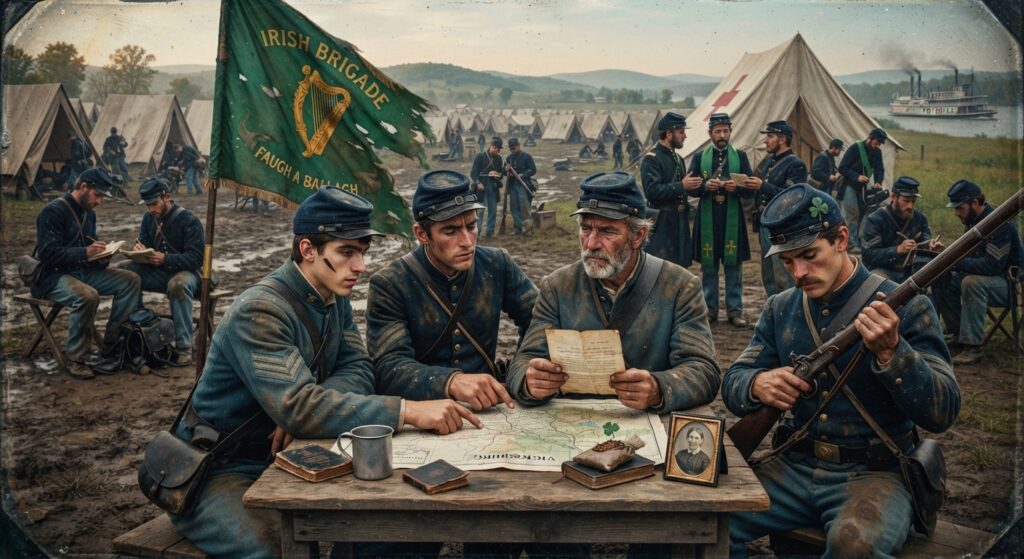
The American Civil War created another important chapter in Irish-American history.
Between 1861 and 1865, Irish immigrants and Irish Americans served in both the Union and Confederate forces.
Irish participation in the Union Army was particularly significant, and Irish-American units became part of the military history of the Civil War.
Military service could strengthen claims of belonging to the United States. For immigrants and their descendants, fighting in the nation’s army could demonstrate a commitment to their new country.
However, the war also exposed class and racial tensions within American cities.
These tensions became particularly visible during the New York City Draft Riots.
The New York City Draft Riots of 1863
The Draft Riots began in New York City in July 1863 after the implementation of federal conscription.
The draft disproportionately affected working-class communities, and the possibility of avoiding service by paying a fee contributed to perceptions that the system favored wealthier Americans.
Irish immigrants and Irish Americans were prominent among the people involved in the unrest, although the riots included a wider range of participants and cannot be understood as an action representing all Irish New Yorkers.
The violence lasted several days and included attacks on African Americans, government facilities, and other targets.
The riots revealed deep divisions involving class, race, immigration, and the Civil War.
They also demonstrate why Irish-American history must be studied within the wider context of American society. Immigrant communities were affected by national conflicts, but they also participated in conflicts over race and political power.
Irish Americans and Tammany Hall
Politics became increasingly important as Irish communities grew.
In New York City, Tammany Hall became one of the country’s most famous political organizations.
The organization developed extensive relationships with immigrant communities and provided political connections and access to services.
For immigrants who lacked wealth or established political influence, these networks could provide practical assistance and opportunities for political participation.
At the same time, Tammany Hall became associated with patronage and corruption.
Its history demonstrates the complicated relationship between immigration and urban politics. Political organizations could help immigrants integrate into city life while simultaneously operating through systems that generated controversy.
Irish Americans eventually became increasingly influential within New York’s political establishment and, later, in political institutions across the country.
Irish Immigration Beyond New York
Although New York is central to the history of Irish immigration, it was not the only destination.
Boston developed a particularly large Irish-American population. Irish immigrants also settled in Philadelphia, Chicago, Baltimore, San Francisco, and numerous smaller cities and towns.
The reasons for settlement varied.
Some immigrants followed relatives. Others went where employment was available. Some moved after initially arriving in New York.
The Irish presence therefore became a national phenomenon rather than simply a New York story.
Different cities produced different versions of Irish-American culture, influenced by local economies, religious institutions, political systems, and relationships with other immigrant communities.
Irish Women in America
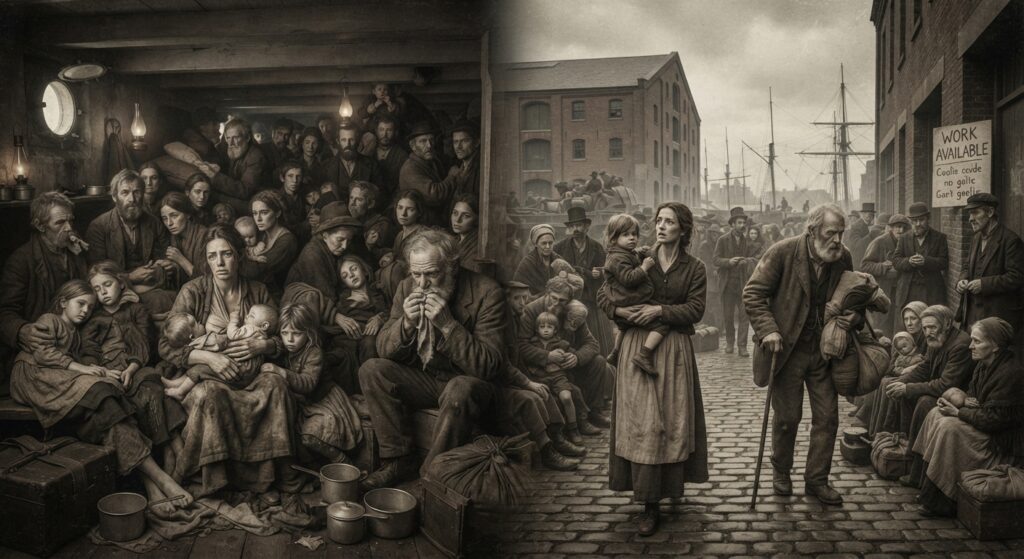
The history of Irish immigration is sometimes told primarily through the experiences of male workers, but women were fundamental to the development of Irish-American communities.
Irish women migrated both independently and as members of families.
Domestic service became one of the most common occupations available to immigrant women, particularly in cities.
Women also played central roles within families and community institutions. They maintained religious traditions, raised children, participated in parish life, and contributed economically to household survival.
For some women, employment in America provided greater financial independence than had been possible in Ireland.
Their experiences also demonstrate that immigration was not exclusively a male economic story. Women actively shaped the development of Irish-American society.
Irish Families and the Second Generation
The children of Irish immigrants often occupied a different position from their parents.
They were born or educated in the United States and were therefore more familiar with American institutions and English-language culture.
At the same time, many grew up in households where Irish traditions, Catholicism, family stories, and connections to Ireland remained important.
The second generation played a major role in the gradual integration of Irish Americans.
Children attended American schools, entered new professions, joined political organizations, and interacted with other ethnic communities.
Over time, Irish identity became increasingly connected to American identity rather than existing separately from it.
From Immigrant to Irish American
The development of Irish-American identity was a gradual process.
Early immigrants might identify strongly with their Irish birthplace, county, religion, or local community.
Their children and grandchildren often described themselves as both American and Irish American.
This dual identity became an important feature of the Irish diaspora.
Irish heritage could be maintained through family traditions, religious practices, music, celebrations, community organizations, and stories about ancestors.
At the same time, Irish Americans became deeply involved in American institutions.
This combination of heritage and integration helped create a distinctive Irish-American identity.
Irish Contributions to American Society
Irish immigrants and their descendants contributed to many areas of American life.
They became workers, business owners, teachers, journalists, soldiers, police officers, politicians, religious leaders, lawyers, artists, and members of numerous other professions.
Irish-American political participation became particularly significant in major cities.
Irish Catholic institutions also helped expand religious and educational networks.
In labor history, Irish workers participated in a variety of organizations and movements, although their experiences were not always separate from conflicts involving other ethnic and racial groups.
The Irish contribution to America was therefore broad and developed over generations.
Irish-American Culture Today
The influence of Irish immigration remains visible in contemporary American culture.
St. Patrick’s Day is perhaps the most recognizable example, but Irish-American heritage extends far beyond the annual celebration.
Irish music, dance, literature, genealogy, family traditions, Catholic institutions, historical societies, and community organizations continue to connect Americans with Irish heritage.
Millions of Americans identify as having Irish ancestry, making Irish heritage one of the most recognizable European ancestral identities in the United States.
This modern identity is the result of generations of migration, adaptation, intermarriage, cultural exchange, and community development.
Irish Genealogy: How to Research Irish Ancestors in America
For people with Irish ancestry, immigration history can become a practical starting point for genealogical research.
Researchers can begin with American records before attempting to identify a specific Irish birthplace.
U.S. census records, naturalization documents, passenger arrival records, church registers, marriage certificates, death certificates, obituaries, cemetery records, and local newspapers can all provide useful clues.
One of the most important pieces of information is the immigrant’s place of origin in Ireland.
Knowing a county, townland, parish, or specific village can make research considerably easier because Ireland’s historical records are often organized geographically.
Family names can also change spelling over time, so researchers should consider alternative spellings when searching historical documents.
Genealogy is therefore another way to understand the broader history of Irish immigration. Behind migration statistics were individual families making decisions that shaped their descendants for generations.
Irish Immigration in Popular Culture
The Irish immigrant experience has inspired numerous books, films, television programs, and other forms of popular culture.
One of the best-known examples is Gangs of New York, which portrays New York during the 19th century and explores conflicts involving immigrant communities, political organizations, and street violence.
The film introduced many viewers to a historical period that included substantial Irish immigration.
However, fictional representations should be distinguished from historical evidence.
Movies frequently combine real events, historical figures, fictional characters, and dramatic storytelling. The actual history of Irish immigrants included not only political conflict and street violence but also ordinary family life, employment, religious institutions, education, business, and gradual social mobility.
Historical records provide a broader picture than popular entertainment alone.
A Timeline of Irish Immigration to America
The history becomes easier to understand when viewed chronologically.
Early 19th century: Irish migration to North America was already taking place before the Great Famine, although the scale increased dramatically later.
1845: The Great Famine began after potato crops were devastated by disease.
1845–1852: Famine, disease, poverty, and mass emigration transformed Ireland.
1850s: Large numbers of Irish immigrants settled in American cities, particularly New York and Boston.
1861–1865: Irish immigrants and Irish Americans participated in the American Civil War on both sides.
1863: The New York City Draft Riots exposed severe tensions involving class, race, immigration, and military conscription.
Late 19th century: Irish-American communities became increasingly established in politics, religion, labor, education, and business.
20th century: Irish Americans became increasingly integrated into American society while continuing to maintain cultural and family connections with Ireland.
Frequently Asked Questions About Irish Immigration to America
When did Irish immigration to America become especially large?
Irish immigration existed before the 19th century, but migration increased dramatically during and after the Great Famine of 1845–1852.
Why did Irish immigrants come to America?
The reasons varied. Poverty, famine, limited economic opportunities, family networks, and the possibility of finding employment in the United States all contributed to migration.
Where did most Irish immigrants settle?
New York and Boston became major centers of Irish settlement, but Irish immigrants also established communities in Philadelphia, Chicago, Baltimore, San Francisco, and many other locations.
What jobs did Irish immigrants have?
Irish immigrants worked in construction, domestic service, factories, transportation, docks, mining, and many other occupations. Employment patterns changed over time and varied according to gender, location, skills, and generation.
Did Irish immigrants face discrimination?
Yes. Irish immigrants experienced ethnic and religious prejudice, particularly because many were Catholic and arrived with limited financial resources. The intensity and form of discrimination varied across communities and over time.
How did Irish immigrants influence America?
Irish immigrants and their descendants contributed to American politics, religion, labor, education, business, military service, culture, and urban development.
How can I find out whether my ancestors were Irish immigrants?
A useful starting point is to identify an American ancestor and work backward through census records, birth and death records, marriage documents, naturalization records, passenger lists, church records, newspapers, and cemetery information. Establishing the immigrant’s Irish county or parish can be especially valuable.
Conclusion: The Lasting Legacy of Irish Immigration
Irish immigration to America was a complex historical process shaped by famine, poverty, economic opportunity, family networks, religion, politics, and the search for security.
The Great Famine accelerated a migration that was already underway and transformed the demographic history of Ireland. For those who crossed the Atlantic, arrival in America did not guarantee an easy life. Many encountered low-paying work, overcrowded housing, discrimination, and unfamiliar social conditions.
Yet Irish immigrants gradually established communities and institutions that helped future generations build more secure lives.
New York became one of the most important centers of Irish-American history, but the story extended across the United States. Irish immigrants and their descendants participated in American religious life, politics, the military, labor, education, business, and culture.
The history of Irish immigration is therefore both a story of displacement and a story of community building.
It also illustrates a broader feature of American history: immigrant communities do not simply enter an existing society. Over time, they influence the institutions, neighborhoods, traditions, and identities that define the country itself.
For millions of Americans today, Irish immigration is not merely a subject of history. It is part of their family history and cultural heritage. Understanding the journeys of Irish immigrants provides an opportunity to connect individual family stories with one of the most important migration movements in the history of the United States.